
Strong core muscles are fundamental for almost every movement you make, offering stability, preventing injury, and improving posture, making a consistent home core workout an incredibly valuable part of any young person’s fitness routine.

Why Core Strength Matters for Everyone
Many people associate core strength solely with visible abdominal muscles, but its importance extends far beyond aesthetics. Your core is the powerhouse of your body, encompassing not just your abs, but also your back muscles, pelvic floor, and diaphragm. It acts as a central link, connecting your upper and lower body and providing a stable foundation for nearly all physical activity.
A robust core supports your spine, significantly reducing the risk of lower back pain, a common complaint even among young individuals. It improves balance and coordination, which is essential for everything from walking and standing to participating in sports and everyday tasks. When your core is strong, movements become more efficient, requiring less effort and minimizing strain on other body parts. This foundational strength enhances athletic performance, whether you’re running, jumping, lifting, or performing complex movements.
Beyond injury prevention and performance, a well-conditioned core contributes to better posture. It helps you stand taller and sit straighter, which can alleviate tension in the neck and shoulders, especially for those who spend a lot of time at desks or looking at screens. Developing this core strengthening early in life sets a positive trajectory for long-term health and fitness, fostering an active lifestyle and overall wellness activity that benefits you for years to come.
Setting Up Your Personal Training Space at Home
One of the best aspects of a home core workout is how little equipment you actually need. You don’t require a fancy home gym setup to achieve effective results. The primary requirement is simply a dedicated, clear space where you can move freely without bumping into furniture or tripping over objects. Even a small corner of a room can suffice for your fitness session.
The most important piece of equipment for any indoor workout, particularly core exercises performed on the floor, is a good exercise mat. A quality mat provides cushioning for your spine and joints, making exercises performed in a supine position or on your elbows much more comfortable. It also offers a non-slip surface, which is vital for maintaining stability and preventing accidental slips during dynamic movements. Look for a mat that is thick enough to provide adequate padding but not so soft that it compromises your balance.
Beyond the mat, consider your workout attire. Comfortable athletic wear that allows for a full range of motion is ideal. Loose-fitting clothes or stretchy fabrics are perfect, ensuring nothing restricts your movement or causes discomfort. While shoes aren’t always necessary for mat-based core work, especially if you prefer to feel the ground with your feet, ensure you have a stable, non-slip surface if you choose to go barefoot. Having a water bottle nearby is also a smart idea to stay hydrated throughout your core engagement.
Essential Core Exercises for a Stronger You
Building a powerful core involves a variety of movements that target different abdominal and back muscles. These bodyweight exercise options are perfect for an at-home fitness regimen, requiring no special equipment beyond your exercise mat.
1. The Plank
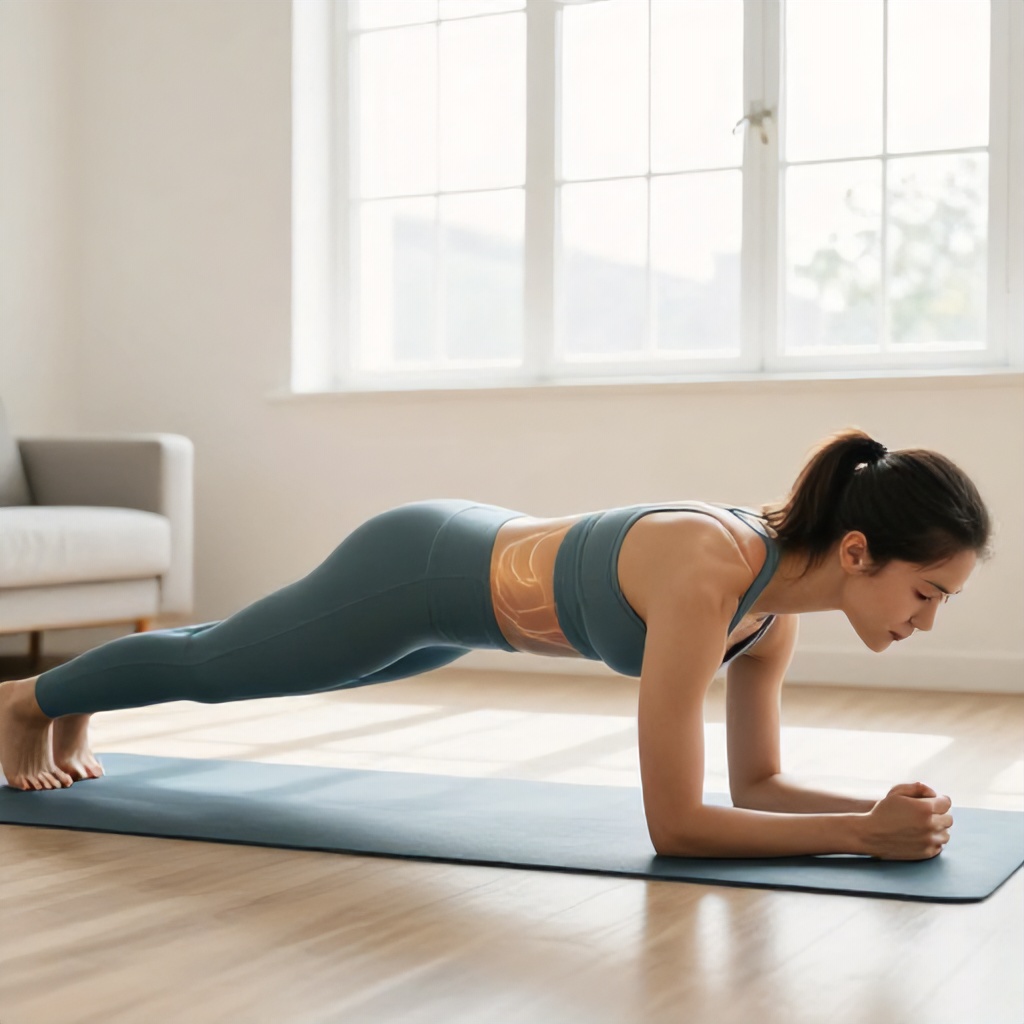
The plank is a cornerstone of core strengthening, engaging almost every muscle in your torso. It’s an isometric exercise, meaning you hold a static position, which builds incredible endurance and stability. To perform a plank, start in a push-up position, then lower down onto your forearms. Your elbows should be directly beneath your shoulders, and your body should form a straight line from your head to your heels. Avoid letting your hips sag or rise too high. Pull your belly button towards your spine, actively engaging your core muscles. Hold this position for as long as you can maintain perfect form, aiming for 30 seconds to a minute initially, gradually increasing your hold time as you get stronger. This exercise participant targets the entire abdominal wall, lower back, and even shoulders and glutes.
2. Abdominal Crunches
The classic abdominal crunch effectively targets the rectus abdominis, the muscle responsible for the “six-pack” look. Lie on your back in a supine position on your exercise mat with your knees bent and feet flat on the floor, hip-width apart. Place your hands lightly behind your head, or cross them over your chest. Engage your core, then slowly lift your head, neck, and shoulders off the mat, curling your upper body towards your knees. Focus on using your abdominal muscles to lift, rather than pulling with your neck. Exhale as you lift and inhale as you slowly lower back down. Perform 10-15 repetitions, focusing on controlled movement rather than speed. This bent-knee exercise is a fundamental movement for torso engagement.
3. Bicycle Crunches
Bicycle crunches are a dynamic exercise that targets both the rectus abdominis and the obliques, the muscles on the sides of your torso. Lie on your back with your knees bent and feet off the floor, as if you’re about to pedal a bicycle. Place your hands lightly behind your head. Bring your right elbow towards your left knee while simultaneously extending your right leg straight. Then, switch sides, bringing your left elbow towards your right knee as you extend your left leg. Keep your lower back pressed into the mat throughout the movement, focusing on a controlled trunk rotation. This oblique crunch variation is excellent for rotational core strength and coordination. Aim for 10-15 repetitions on each side.
4. Leg Raises
Leg raises are fantastic for targeting the lower abdominal muscles. Lie flat on your back on your mat, with your legs extended straight. You can place your hands under your lower back for support if needed, or keep them by your sides. Keeping your legs straight (a slight bend in the knee is okay if your hamstrings are tight), slowly lift them towards the ceiling until they are perpendicular to the floor, or as high as you can go without arching your lower back. Control the movement as you slowly lower your legs back down, stopping just before they touch the mat to maintain core engagement. Avoid letting your back arch off the floor. Perform 10-15 slow and controlled repetitions.
5. Bird-Dog
The bird-dog exercise is excellent for improving core stability, balance, and coordination, while also strengthening the lower back. Start on your hands and knees in a tabletop position, with your wrists directly under your shoulders and knees directly under your hips. Keep your back flat and your core tight. Slowly extend your right arm straight forward and your left leg straight back simultaneously, maintaining a stable torso. Imagine a straight line from your extended hand to your extended foot. Hold for a moment, then slowly return to the starting position. Alternate sides, extending your left arm and right leg. Perform 8-12 repetitions on each side, focusing on slow, controlled movements and minimal rocking of your body.
6. Russian Twists
Russian twists are another effective exercise for targeting the obliques and improving rotational strength. Sit on your mat with your knees bent and feet flat on the floor. Lean back slightly, keeping your back straight and your core engaged. Lift your feet off the floor, balancing on your sit bones. You can keep your hands clasped in front of your chest or hold a light weight (like a water bottle) for added resistance. Twist your torso from side to side, bringing your hands or the weight towards the mat on each side. Keep the movement controlled and focus on rotating from your core, not just your arms. Aim for 10-15 twists on each side, ensuring your spine remains elongated throughout the trunk rotation.
7. Side Plank
The side plank is a powerful exercise for strengthening the oblique muscles and improving lateral core stability. Lie on your side on your mat, with your forearm on the floor directly beneath your shoulder. Stack your feet one on top of the other, or place your top foot slightly in front of the bottom one for more stability. Lift your hips off the floor, forming a straight line from your head to your heels. Engage your core and glutes, ensuring your hips don’t sag. Hold this position for 20-45 seconds, then switch to the other side. This exercise requires significant torso engagement and builds strength that protects your spine from side-to-side forces.
Building Your At-Home Fitness Routine
Consistency is key when it comes to any fitness routine. For core strengthening, aim to perform these abdominal exercises 3-4 times per week, allowing a day of rest in between sessions for muscle recovery. You don’t need to do every exercise every time; you can pick 3-5 exercises and perform 2-3 sets of each.
Always start your fitness session with a brief warm-up, like marching in place or gentle arm circles, to prepare your muscles. Conclude with a cool-down, including some light stretching for your abs and back. Listen to your body and never push through sharp pain. Proper form is always more important than the number of repetitions you complete. As you get stronger, you can increase the number of sets, repetitions, or the duration of your holds.
Common Mistakes to Avoid During Your Core Workout
Even with simple bodyweight exercises, it’s easy to fall into common traps that can reduce effectiveness or even lead to injury. Being aware of these pitfalls will help you maximize your home core workout.
- Rushing Through Movements: Speed often compromises form. Slow, controlled movements ensure your muscles are doing the work, not momentum.
- Holding Your Breath: Remember to breathe deeply and consistently throughout each exercise. Exhale on the exertion phase and inhale on the release. Holding your breath can raise blood pressure and reduce core engagement.
- Arching Your Lower Back: This is a very common mistake, especially in exercises like leg raises or planks. An arched back indicates your core isn’t fully engaged, putting strain on your spine. Always aim to keep your lower back pressed towards the mat or maintain a neutral spine.
- Pulling on Your Neck: During crunches or bicycle crunches, avoid pulling your head forward with your hands. Your hands are there for support, not to lift your head. Focus on lifting with your abdominal muscles.
- Neglecting Full Core Engagement: It’s not just about moving. Actively think about “bracing” your core, as if preparing for a punch to the stomach. This ensures deep muscle activation.
- Overdoing It: More isn’t always better. Overtraining can lead to fatigue, poor form, and injury. Stick to your planned sets and reps, and allow for rest days.
Progression and Consistency for Lasting Results
As you become stronger, the exercises that once challenged you will start to feel easier. This is a sign of progress, and it’s also your cue to introduce new challenges to continue building strength. There are several ways to progress your home core workout.
You can increase the duration of holds for isometric exercises like planks and side planks. For dynamic movements like crunches or leg raises, you can increase the number of repetitions or add more sets. Another excellent method is to introduce variations of the exercises. For example, once regular planks are easy, try plank jacks or planks with hip dips. For crunches, you might move to decline crunches if you have an appropriate setup, or add a small weight to your chest. Leg raises can become even more challenging by performing them with perfectly straight legs, or by slowing down the lowering phase even further.
The most important factor, however, is consistency. Showing up for your personal training space sessions, even on days when you don’t feel entirely motivated, is what builds lasting strength and an active lifestyle. Small, regular efforts accumulate into significant gains over time. Don’t get discouraged by slow progress; every wellness activity session contributes to your overall health and fitness journey.
Tips for Staying Motivated with Your Core Routine
Maintaining motivation for any physical activity can be tough, but a few simple strategies can keep you engaged with your home core workout.
- Set Realistic Goals: Instead of aiming for a “six-pack in a week,” focus on achievable goals like “hold a plank for 60 seconds” or “complete 3 core sessions this week.”
- Track Your Progress: Keep a simple journal or use a fitness app to log your exercises, reps, sets, and hold times. Seeing your improvements over time is a powerful motivator.
- Vary Your Exercises: Don’t stick to the exact same routine every time. Introduce new core exercises from time to time to keep things fresh and challenge your muscles in different ways.
- Create a Positive Environment: Put on your favorite upbeat music, ensure your personal training space is tidy, and wear comfortable workout attire. A pleasant environment makes you more likely to start.
- Focus on How You Feel: Remember the non-aesthetic benefits of core strength: better posture, less back pain, improved balance, and enhanced overall physical activity. These internal rewards can be more motivating than external appearances.