
Strengthening your glutes and lower back at home is entirely achievable and incredibly beneficial for overall body health, posture, and preventing discomfort. These muscle groups, often referred to as your posterior chain, work together to support your spine, power your movements, and keep you moving freely throughout your day.

Why Strong Glutes and a Healthy Lower Back Matter
Having robust gluteal muscles and a stable lower back is more than just about aesthetics; it is fundamental for functional movement and pain prevention. These muscle groups are central to almost every physical activity, from standing and walking to lifting and running. When they are weak or imbalanced, other parts of your body, particularly your knees and upper back, often pick up the slack, leading to strain and potential injury.
Your glutes and lower back muscles form a powerful partnership. Strong glutes help stabilize your pelvis, which in turn reduces stress on your lumbar spine. Conversely, a strong lower back provides essential support for your core, allowing your glutes to function more efficiently. Neglecting either can create a domino effect of issues, impacting everything from your posture to your ability to perform simple daily tasks without discomfort.
Understanding Your Posterior Chain: A Quick Anatomy Lesson
To effectively target your muscles with physical exercises, it helps to understand a little about what you’re working. The posterior chain refers to all the muscles on the backside of your body, and for our purposes, we’re focusing on the glutes and the muscles supporting your lower back. This basic muscular anatomy knowledge can enhance your muscle activation during home workouts.
The Gluteal Muscles
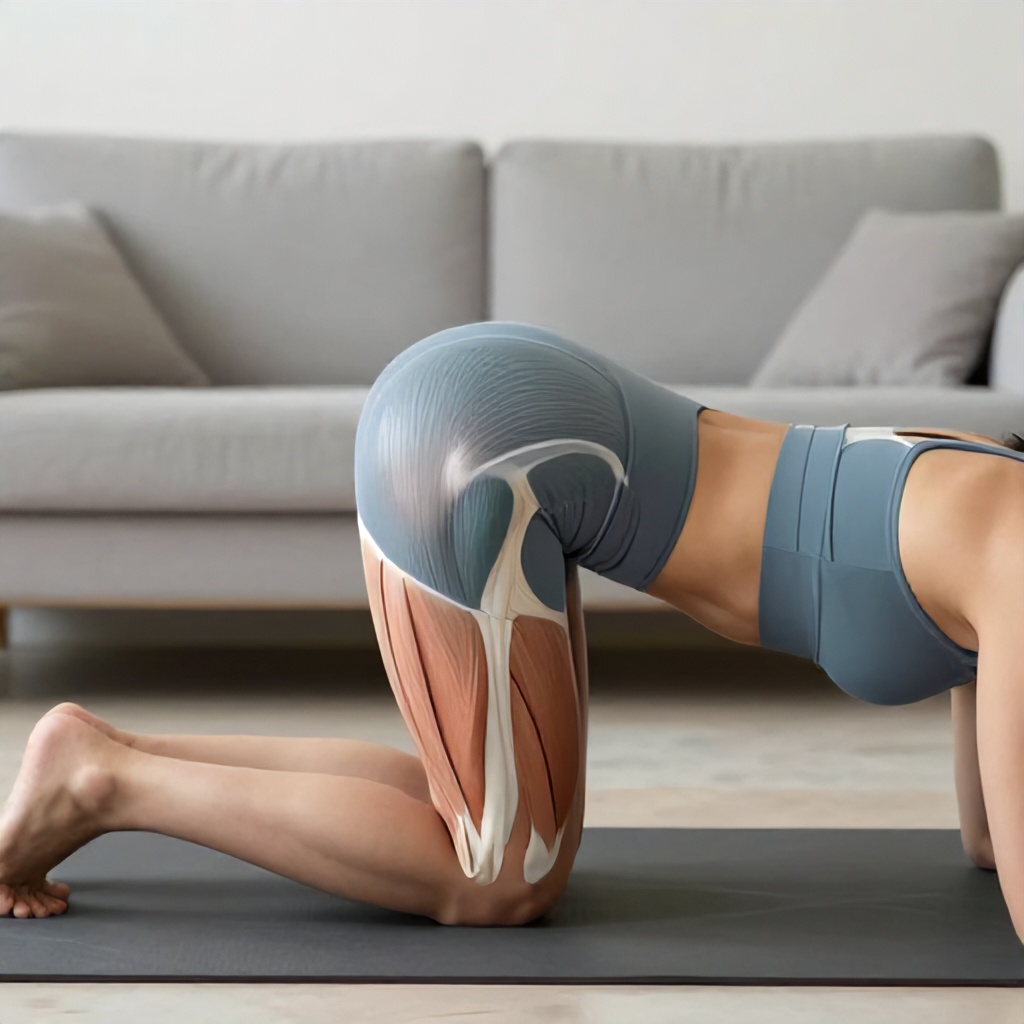
Your glutes are actually a group of three distinct muscles, each playing a vital role in hip movement and stability. The gluteus maximus is the largest and most powerful, responsible for extending your hip (like when you stand up from a chair). The gluteus medius and gluteus minimus sit beneath the maximus, crucial for abducting your leg (moving it out to the side) and stabilizing your pelvis during walking and running. Understanding these muscle groups helps you appreciate why targeted glute exercises are so important.
Visualizing these muscles, perhaps with anatomical diagrams, can make the connection between an exercise pose and the muscle being worked much clearer. When you perform a glute bridge, for instance, you can feel the gluteus maximus contracting to lift your hips. These muscles are key players in your overall body mechanics.
The Lumbar Muscles
The lower back, or lumbar region, is supported by a complex network of muscles. The erector spinae group runs along your spine, helping you extend and rotate your back. Deeper muscles like the multifidus provide segmental stability to each vertebra. These muscles are integral to maintaining good posture and protecting your spine from injury. Developing core strength, which includes these lumbar muscles, is paramount for a healthy back.
Effective lower back exercises often focus on controlled movements that strengthen these supportive muscles without putting excessive strain on the spine itself. Think of them as the unsung heroes that keep your trunk upright and stable. An exercise infographic often highlights these connections, making fitness education more accessible.
Essential Targeted Glute Exercises for Your Home Workout
You don’t need fancy equipment to build strong glutes. These bodyweight exercises are incredibly effective and can be done right in your living room. Focus on proper exercise technique to get the most out of each movement and prevent injury.
Glute Bridge
The glute bridge is a fantastic foundational exercise for activating your gluteal muscles, particularly the gluteus maximus. It also gently engages your lower back and core for stability.
- Lie on your back with your knees bent, feet flat on the floor hip-width apart, and heels a few inches from your glutes. Your arms should be by your sides, palms down.
- Engage your core and glutes, pressing your feet into the floor as you lift your hips towards the ceiling. Form a straight line from your shoulders to your knees.
- Squeeze your glutes at the top of the movement. Avoid arching your lower back excessively.
- Slowly lower your hips back down to the starting position with control.
- Aim for 3 sets of 10-15 repetitions.
Donkey Kicks
Donkey kicks are excellent for isolating and strengthening the gluteus maximus and improving hip extension. This exercise helps with muscle activation in a controlled manner.
- Start on all fours, hands directly under your shoulders and knees under your hips. Keep your back flat and core engaged.
- Keeping your knee bent at a 90-degree angle, lift one leg straight up behind you, pushing your heel towards the ceiling.
- Squeeze your glute at the top of the movement. Avoid arching your back or letting your hips twist.
- Slowly lower your leg back to the starting position without letting your knee touch the floor completely.
- Perform 3 sets of 10-15 repetitions on each leg.
Clamshells
Clamshells are specifically designed to target the gluteus medius, a crucial muscle for hip stability and preventing knee pain. This is a great addition to any workout routines focusing on hip health.
- Lie on your side with your knees bent at about a 45-degree angle and stacked on top of each other. Rest your head on your bottom arm or support it with your hand.
- Keep your feet together and your hips stacked. Engage your core.
- Keeping your feet touching, slowly lift your top knee towards the ceiling, like a clamshell opening. Stop when you feel your hips begin to tilt.
- Hold briefly, squeezing the glute of your top leg.
- Slowly lower your knee back down with control.
- Complete 3 sets of 12-18 repetitions on each side.
Lunges (Reverse Lunges)
Lunging exercises are fantastic compound movements that work the glutes, quadriceps, and hamstrings, improving balance and unilateral strength. Reverse lunges are often easier on the knees than forward lunges.
- Stand tall with your feet hip-width apart, hands on your hips or by your sides.
- Take a large step backward with one leg, lowering your hips until both knees are bent at approximately a 90-degree angle. Your front knee should be directly over your ankle, and your back knee should hover just above the floor.
- Ensure your front foot is flat and your weight is evenly distributed.
- Push off your back foot to return to the starting standing position.
- Alternate legs, performing 3 sets of 8-12 repetitions per leg.
Squats (Bodyweight)
Bodyweight squats are a fundamental movement pattern that strengthens the entire lower body, including the glutes, quadriceps, and hamstrings, while also engaging your core. They are a cornerstone of strength training.
- Stand with your feet shoulder-width apart, toes pointing slightly out. Keep your chest up and core engaged.
- Initiate the movement by pushing your hips back as if you’re sitting in a chair. Lower your body until your thighs are parallel to the floor, or as low as comfortable while maintaining good form.
- Keep your knees tracking over your toes, not caving inward. Your weight should be in your heels.
- Drive through your heels to return to the standing position, squeezing your glutes at the top.
- Perform 3 sets of 10-15 repetitions.
Effective Lower Back Exercises You Can Do Anywhere
These lower back exercises focus on strengthening the muscles that support your spine and improve core stability. Remember to move slowly and with control, paying close attention to your body.
Bird-Dog
The bird-dog is a classic exercise for improving core strength, stability, and coordination, specifically targeting the lumbar muscles and deep core stabilizers without putting stress on the spine.
- Start on all fours, hands directly under your shoulders and knees under your hips. Keep your back flat and core engaged, looking down to maintain a neutral neck.
- Slowly extend one arm straight forward and the opposite leg straight back simultaneously. Keep your hips level and avoid arching your back.
- Imagine you have a glass of water on your lower back that you don’t want to spill.
- Hold for a few seconds, feeling the engagement in your core and lower back.
- Return to the starting position with control.
- Alternate sides, performing 3 sets of 8-12 repetitions on each side.
Superman
The superman exercise directly targets the erector spinae muscles along your spine, helping to strengthen your lower back and improve posterior chain endurance. It’s an excellent bodyweight exercise for spinal health.
- Lie face down on the floor with your arms extended straight in front of you and your legs extended straight behind you.
- Keep your neck neutral, looking down at the floor.
- Simultaneously lift your arms, chest, and legs off the floor a few inches. Squeeze your glutes and feel the engagement in your lower back.
- Hold this position for 2-3 seconds, then slowly lower back down to the starting position.
- Perform 3 sets of 10-15 repetitions.
Cat-Cow Stretch
While primarily a stretch, the cat-cow movement is fantastic for warming up the spine, improving spinal mobility, and gently engaging the core and lumbar muscles. It’s a great preparation or cool-down for any workout routines.
- Start on all fours, hands directly under your shoulders and knees under your hips. Maintain a neutral spine.
- For the “Cow” pose: Inhale as you drop your belly towards the floor, lifting your chest and tailbone towards the ceiling. Gently arch your back.
- For the “Cat” pose: Exhale as you round your spine towards the ceiling, tucking your chin to your chest and pulling your navel towards your spine.
- Flow smoothly between these two poses, synchronizing with your breath.
- Perform 10-15 cycles as a warm-up or cool-down.
Crafting Your Home Workout Routines
Combining these physical exercises into a structured routine is key to seeing results. Consistency is more important than intensity when you’re starting out. Think about creating a balanced workout that addresses both gluteal muscles and lumbar muscles.
Sets and Repetitions
For strength training, a common guideline is to perform 2-4 sets of 8-15 repetitions for each exercise. If an exercise feels too easy, you can increase the repetitions, slow down the movement, or add a brief pause at the peak contraction to enhance muscle activation. As you get stronger, you might consider adding resistance bands for an extra challenge to your bodyweight exercises.
Frequency and Progression
Aim to perform these targeted glute and lower back exercises 2-3 times per week, allowing a day of rest in between for muscle recovery. As you progress, you can gradually increase the number of sets, repetitions, or the difficulty of the exercise poses. Remember, gradual progression is safer and more sustainable than trying to do too much too soon.
Warm-up and Cool-down
Always begin your workout with a 5-10 minute warm-up of light cardio (like marching in place) and dynamic stretches (like leg swings and cat-cow). This prepares your muscles for activity. Finish with a 5-10 minute cool-down of static stretches, holding each stretch for 20-30 seconds. This improves flexibility and aids in recovery.
Important Tips for Safe and Effective Exercise
While these home workouts are generally safe, paying attention to your body and form is paramount. Fitness education emphasizes listening to your body’s signals.
- Focus on Form: Prioritize correct exercise technique over speed or the number of repetitions. If you’re unsure, imagine a visual exercise guide demonstrating the perfect form. Poor form can lead to injury and less effective muscle activation.
- Breathe Properly: Don’t hold your breath. Exhale during the exertion phase (the hardest part of the movement) and inhale during the release phase.
- Consistency is Key: Regularity is far more effective than sporadic intense sessions. Even short, consistent workouts yield better long-term results.
- Stay Hydrated: Drink plenty of water before, during, and after your workout to support muscle function and recovery.
- Listen to Your Body: If you feel sharp pain, stop the exercise immediately. Some muscle soreness is normal after a workout, but pain is a warning sign. Consult a healthcare professional if you experience persistent pain.
Bringing It All Together: Your Path to a Stronger Posterior Chain
Building a strong posterior chain, encompassing your gluteal muscles and lumbar muscles, is an investment in your long-term health and well-being. By incorporating these targeted glute and lower back exercises into your home workouts, you’re not just strengthening muscles; you’re improving your posture, reducing the risk of back pain, and enhancing your body’s overall functional capacity. Start small, stay consistent, and enjoy the benefits of a stronger, more resilient you.